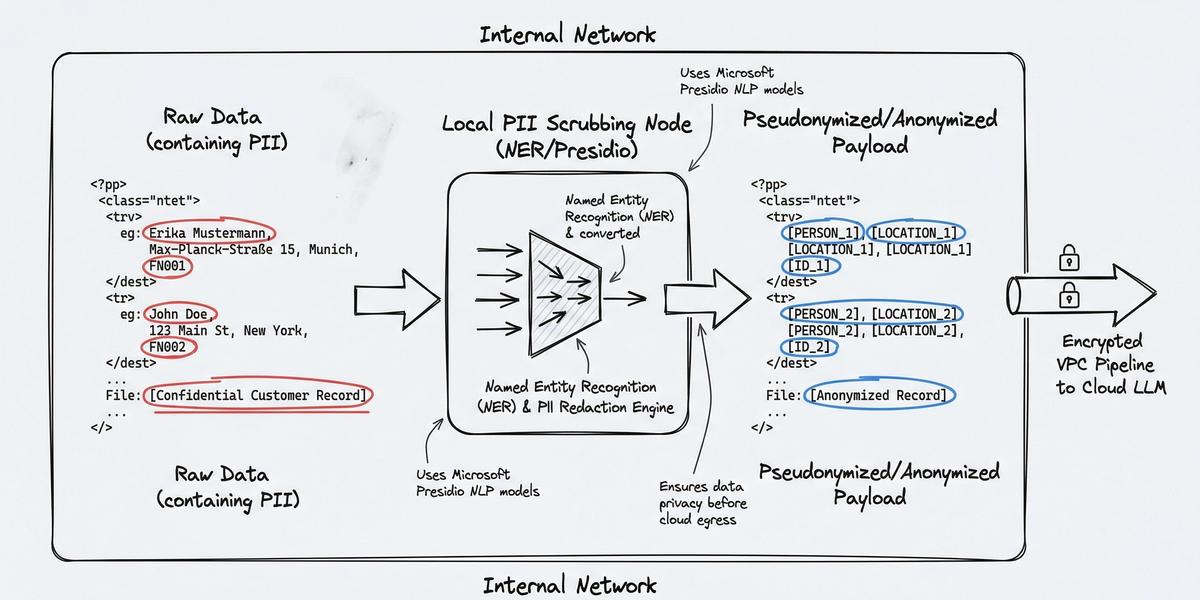
The assumption that cutting-edge AI is inherently incompatible with European data privacy laws is a significant barrier to enterprise innovation. While utilizing regional models or building hybrid infrastructures (routing sensitive data locally and general queries to the cloud) provides theoretical data sovereignty, these approaches introduce massive architectural complexity, maintenance overhead, and often a noticeable drop in complex reasoning and inference capabilities.
The technical reality is that organizations can deploy frontier models securely and compliantly. This requires shifting the focus from the model’s origin to the surrounding infrastructure and governance layers. Here is the framework for deploying top-tier LLM APIs compliantly:
1. Enterprise Sovereign Infrastructure for Frontier Models
Frontier models can be utilized compliantly when accessed through enterprise cloud environments (such as Microsoft Azure, Google Cloud, or AWS) rather than public-facing consumer endpoints.
- Strict EU Data Residency: Deployments must be hardcoded to specific European data centers (e.g., Frankfurt, Paris) ensuring processing and storage never leave the EU.
- Zero Data Retention (ZDR) and No-Training SLAs: Executing a Data Processing Agreement (DPA) is standard, but the critical requirement is an SLA explicitly guaranteeing that enterprise prompts, RAG context windows, and generated outputs are not used for model training and are permanently purged from memory immediately following inference. [1]
2. Network-Level Isolation
Compliance requires eliminating exposure to the public internet during data transit.
- Implement Virtual Private Clouds (VPCs) and Private Links.
- By mapping the cloud-hosted LLM endpoint directly into your internal network architecture, data traffic between your internal servers and the frontier model remains on a private, encrypted backbone.
3. Precision Data Scrubbing (PII Masking)
Instead of maintaining a complex secondary local LLM for sensitive data, implement a lightweight, robust filtering layer before data leaves your network boundary.
- Utilize local NLP tools configured for Named Entity Recognition (NER).
- Pseudonymize Personally Identifiable Information (PII) before the payload is transmitted to the cloud API.
- The frontier model processes only the anonymized prompt, and your internal application logic maps the generated response back to the authentic data upon return. This neutralizes the GDPR risk of cloud processing.
4. EU AI Act Readiness
Deploying frontier models via enterprise APIs also aligns with the stringent requirements of the EU AI Act.
- Deployer Obligations: As an enterprise using an API, your system is typically classified under the AI Act based on its use case. Provided the system is not utilized for prohibited practices or high-risk categories without proper conformity assessments, utilizing a frontier model is permissible.
- Transparency and Governance: Enterprise APIs provide the necessary logging, access controls, and output monitoring required to fulfill AI Act transparency mandates, proving human oversight and systemic traceability.
DexterBee provides the strategic roadmap and technical expertise to help your business lead in the age of intelligence. Contact us to scale your AI vision.
---
[1] Fact-Check & Enterprise SLA References: Skepticism regarding data retention is common but often confuses consumer AI terms (like ChatGPT Plus or Gemini Advanced) with Enterprise Cloud SLAs.
- Google Cloud (Vertex AI / Gemini): Google’s AI/ML Privacy Commitment explicitly states that customer data (prompts and responses) submitted to Vertex AI is not used to train foundation models.
- Microsoft Azure (OpenAI / GPT-4): Azure OpenAI inherently does not use customer data to train models. While Azure maintains a default 30-day log for abuse monitoring, enterprise customers can formally apply for a “Modified Abuse Monitoring Exemption,” which legally guarantees Zero Data Retention (ZDR) and no human review.
- AWS Bedrock (Anthropic Claude): AWS guarantees that customer data is never used to train the base models and that model partners (like Anthropic) access the data via zero data retention endpoints securely within your VPC.