A significant portion of enterprise AI investment is currently failing to deliver the projected Return on Investment (ROI). The primary cause is not a lack of compute power or model capability, but a fundamental categorization error in the C-Suite: the confusion of automation with agency.
To build a scalable AI strategy, technical leadership must stop classifying every implementation as an "AI Agent." There is a distinct hierarchy of intelligence. Misidentifying where your current stack sits within this hierarchy leads to misaligned expectations and brittle infrastructure.
Here is the technical breakdown of the four distinct layers of AI implementation.
1. LLM Chatbots (The Interface Layer)
Function: Probabilistic Text Generation.
Large Language Models (LLMs) in isolation are non-agentic. When a user prompts an LLM, it predicts the next token based on training data.
- Capabilities: They answer questions, summarize text, and translate languages.
- Limitations: They do not make decisions. They do not execute tools. They do not "own" an outcome.
- Strategic Classification: These are interfaces, not workers.
2. RPA (Robotic Process Automation)
Function: Deterministic Execution.
RPA is the legacy standard for automation. It relies on strict, rule-based scripts (If X, then Y, else Z).
- Capabilities: High speed and accuracy for repetitive, unchanging tasks (e.g., invoice scraping).
- Limitations: RPA is brittle. It possesses zero reasoning capabilities. If an edge case occurs—such as a changed UI element or an unexpected data format—the script breaks immediately.
- Strategic Classification: These are assembly lines, not decision-makers.
3. RAG Systems (Retrieval-Augmented Generation)
Function: Contextual Intelligence.
RAG architectures solve the hallucination and knowledge cutoff problems of vanilla LLMs by fetching relevant data from a vector database before generating an answer.
- Capabilities: High-accuracy information retrieval useful for internal support, documentation search, and compliance Q&A.
- Limitations: While they have access to proprietary data, they do not plan or act upon it. They are passive systems.
- Strategic Classification: This is memory, not intelligence.
4. Agentic Systems (Digital Workers)
Function: Probabilistic Reasoning and Orchestration.
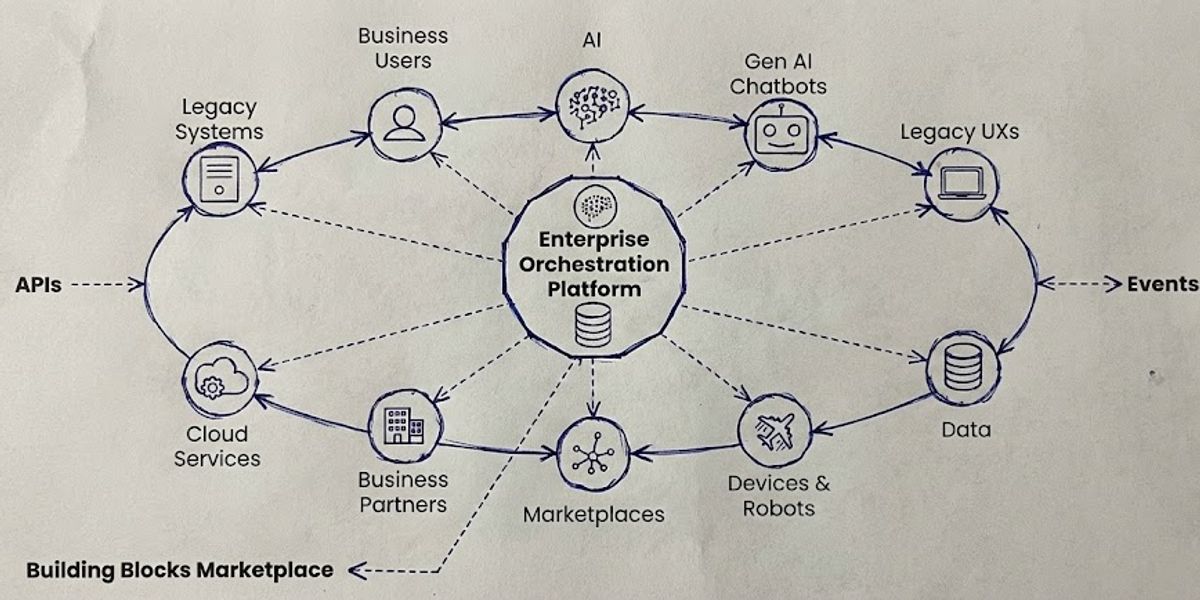
A true AI Agent is defined by its ability to pursue a goal autonomously. Unlike RPA, it does not follow a rigid script; it follows a workflow governed by an "Orchestrator" (often a high-reasoning model like GPT-4o or Claude 3.5 Sonnet).
The Core Loop of Agency:
- Planning: The agent breaks a high-level objective (e.g., "Qualify this lead") into sub-tasks without human intervention.
- Acting: It interacts with external environments via APIs—updating CRMs, sending emails, or triggering deployment pipelines.
- Remembering: It utilizes long-term memory (databases/logs) to maintain state across the workflow and learn from feedback.
- Collaborating: Sophisticated systems use multi-agent frameworks where specialized agents (a coder, a reviewer, a deployer) hand off tasks to one another.
The Strategic Shift: From Automation to Autonomy
The distinction is operational:
- Automation follows orders.
- Autonomy figures them out.
If your "AI project" requires a human to constantly prompt it or fix broken scripts, you have built a chatbot or a fragile automation. To achieve the scalability promised by the "Age of Intelligence," organizations must transition to Agentic Workflows that deploy true digital workers capable of reasoning through ambiguity.
DexterBee provides the strategic roadmap and technical expertise to help your business lead in the age of intelligence. Contact us to scale your AI vision.