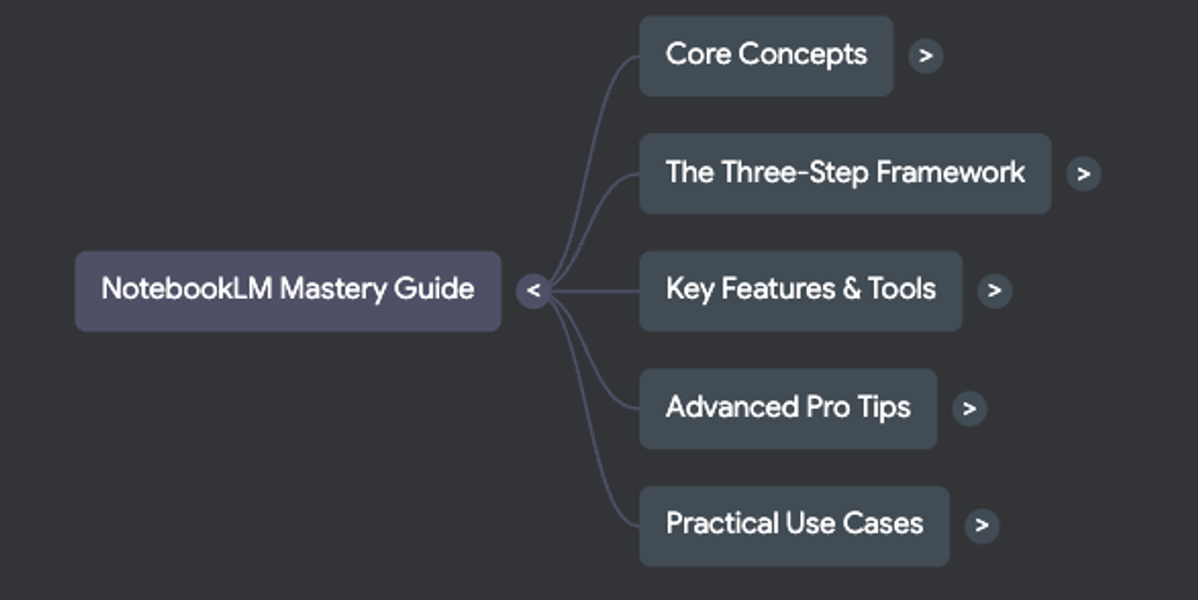
Here is an in-depth mastery guide for utilizing Google NotebookLM not merely as a simple chatbot, but as a "Research Intelligence System."
In this guide, you will learn about the three-stage framework—Curate, Learn, and Act— which will help you to transition from casual use to professional workflows. Read till very end to learn about specific strategies and advanced use cases for each stage, ultimately to learn about how to maximize productivity and derive high-quality outputs through NotebookLM.
1. NotebookLM Mastery Guide
- Paradigm Shift: NotebookLM should be perceived and utilized as a strategic "Research Intelligence System" rather than a basic chatbot.
- Three-Stage Professional Workflow: NotebookLM is best used with a systematic approach consisting of Curate (information collection and organization), Learn (information analysis and learning), and Act (output generation and application).
- Core Strategies of the Curate Stage:
- Topic-Specific Notebook Creation: Create notebooks with specific topics, such as "Q1 2026 Competitive Analysis," to prevent AI confusion.
- Multimodal Resource Utilization: Mix various formats like PDFs, YouTube videos, and web articles to secure a 360-degree perspective.
- Autonomous Sourcing (Deep Research): Instruct the AI to automatically find and read up to 50 sources to generate a report.
- Source Hygiene Management: Immediately remove failed links and pin important sources to the top with labels like "!Key Report."
- Importance of Validation Protocol: Highlights the "Validation" step—overlooked by 99% of users—as a core factor determining output quality.
- Source Audit: Evaluate reliability by analyzing the publication date, author, and potential bias of each source.
- Obsolescence Check: For AI or tech-related materials, it recommends removing sources older than 18 months.
- Information Gap Analysis: Ask the AI to identify missing perspectives or counterarguments and search for additional sources to fill those gaps.
- Precision Control in the Learn Stage:
- Source Filtering: Induce accurate responses by selecting only the specific sources required for a particular question.
- Persona Definition: Assign specific roles to the AI via "Configure" settings, such as "Strict Editor" or "Unit Economics First."
- Interactive Audio: Utilize the "Join" feature during Audio Overview generation to ask questions and request explanations in real-time.
- Content Generation in the Act Stage:
- Customized Audio Briefing: Before generating an Audio Overview, use the "pencil icon" to instruct the AI to focus on specific topics (e.g., disagreements between authors).
- Visual Material Generation: Generate infographics and slide decks through Studio features, providing specific design instructions (e.g., "Navy and White color scheme").
- Recursive Workflow: Presents a circular structure: Question → Save Note → Convert Note to Source → Use new sources to generate additional materials (slide decks, social media posts).
- Advanced Use Cases:
- App Development: Build software without coding by having the AI generate "technical prompts for app builders" after market research.
- YouTube Automation: Reverse-engineer success strategies by analyzing competitor channel videos to extract "hook structures," "script patterns," and "viral topics."
- Education: Upload textbooks to request "quizzes with 5 multiple-choice questions and explanations" or to "explain this concept to a 3rd grader."
2. Shifting Gears : You Are the Master
In order to effectively utilize NotebookLM, the AI should be recognized not as a simple information retrieval tool, but as an "active partner" that selects, analyzes, and produces final outputs based on the user's intent.
The "Curate, Learn, Act" framework appears to be a reconfiguration of traditional research methodologies optimized for the AI environment. It focuses on quality over quantity and active "information engineering" rather than passive acquisition. In particular, the "Validation Protocol" stage conveys the important message that users must proactively verify and supplement information while acknowledging the AI's potential limitations (hallucinations, bias, information obsolescence). This suggests that critical thinking and human intervention are essential in the use of AI.
Furthermore, features like source filtering, persona definition, and customized audio/visual generation provide methods to precisely control AI output according to specific purposes and contexts. These are key strategies for obtaining tailored results that meet unique user needs beyond generic answers. Advanced techniques like the "Recursive Workflow" demonstrate NotebookLM's potential as a "Content Factory" for evolving ideas and producing diverse forms of content.
The advanced use cases clearly reveal the versatility and scalability of NotebookLM. They show that it can be used creatively across a wide range of fields—from research and learning to app development, marketing strategy, and educational content creation—indicating that AI tools are evolving into assistants for diverse professional tasks.
What remains crucial is that the user acts as the master. When effectively used, NotebookLM becomes your great assistant(s).
3. Implications
- Growing Importance of AI Utilization Capabilities: Beyond simply knowing how to use AI tools, the competency of "how" to use them strategically will determine the productivity and competitiveness of individuals and organizations.
- Innovation in Knowledge Work Efficiency: For knowledge workers whose primary tasks involve information processing and content production—such as researchers, analysts, creators, and students—tools like NotebookLM can be powerful means to reduce work time and improve output quality.
- Essential Nature of Critical AI Literacy: The emphasis on the "Validation Protocol" highlights the importance of "AI Literacy"—the ability to think critically and verify the accuracy, bias, and recency of AI-generated information.
- Expansion of Creative Productivity: Advanced cases like app development and YouTube automation open possibilities for realizing ideas and producing content without specialized technical skills, fostering creative attempts across various sectors.
- Potential Shifts in Education: Educational applications such as textbook analysis and quiz generation show that AI can contribute to providing personalized learning experiences and reducing the administrative burden on educators.
4. Conclusion and Recommendations
Google NotebookLM is a powerful "Research Intelligence System" that goes beyond a simple organization tool. Through the systematic "Curate, Learn, Act" framework and various advanced features, it can innovatively enhance a user's research and content production capabilities.
Recommendations:
- Strategic Learning and Application: Users should actively learn the framework and strategies presented in this guide and apply them to their actual workflows.
- Quality Control of Input Information: Since AI output quality depends heavily on input, users should focus on securing the reliability and recency of sources through multimodal sourcing, hygiene management, and the "Validation Protocol."
- Active AI Control: Utilize features like source filtering, persona definition, and customized instructions to derive goal-oriented results rather than generic responses.
- Exploration of Diverse Use Cases: Experiment with advanced cases such as app development and YouTube automation to realize the full potential of NotebookLM and create new value.
- Continuous Feedback and Improvement: Given the nature of AI tools, it is important to find optimal usage patterns through continuous user feedback and iterative refinement.